Institutional Architecture for Cryptocurrency Exchanges: Engineering Scalability, Security, and Profitability

Executive Overview
A deep-dive analysis into the structural components of a tier-1 crypto exchange, focusing on matching engine performance, MPC custody, and hybrid revenue models.
This guide is written with an operational perspective for brokerage executives, technical teams, and investors who need an executable output.
Table of Contents
As digital assets transition from speculative instruments to fundamental financial infrastructure, the requirements for launching an exchange have reached institutional levels. Building a sustainable exchange in 2026 demands a sophisticated orchestration of high-frequency matching technology, multi-layered security protocols, and advanced liquidity management.
1. High-Performance Matching Engine (ME) Architecture
The Matching Engine is the competitive core of an exchange. For institutional-grade operations, a monolithic approach is no longer viable. Modern exchanges deploy micro-services-based ME clusters.
- Latency Control: Implementing O(1) complexity matching algorithms to ensure execution speed remains constant regardless of order book depth.
- Throughput Scalability: Utilizing horizontal scaling and memory-first data persistence (using technologies like Redis or specialized in-memory databases) to handle millions of trades per minute during peak volatility.
- Order Lifecycle Governance: Sophisticated handling of Cancel-Replace (C/R) orders and priority queueing to prevent front-running and ensure market integrity.
2. Custody and Wallet Infrastructure: The Security Benchmark
Asset security is the ultimate trust metric. A robust exchange must utilize a "defense-in-depth" wallet architecture.
- MPC (Multi-Party Computation) Custody: Moving beyond traditional multi-sig to MPC, which eliminates single points of failure by distributing private key shards across multiple secure environments.
- Cold Storage Air-Gapping: Ensuring that the vast majority of user assets are held in offline environments with physical and cryptographic air-gaps, requiring manual multi-person approval for movement.
- Real-time Proof of Reserves (PoR): Implementing Merkle-tree-based PoR systems to allow users to verify the exchange’s solvency and asset coverage in real-time.
Institutional Crypto Exchange Revenue Architecture
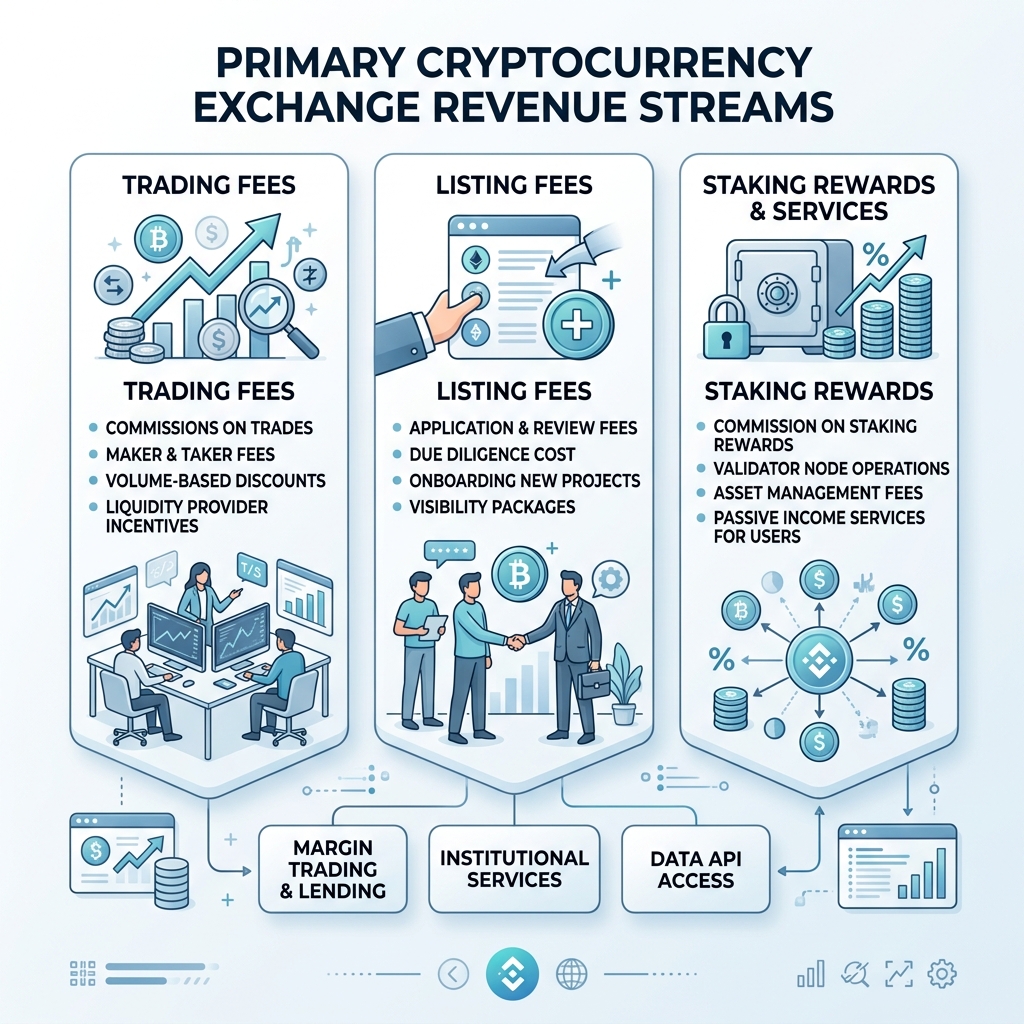
Strategic mapping of primary trading revenues and secondary value-added services for Tier-1 platforms.
3. Liquidity Strategy: Order Book vs. RFQ Models
An exchange is only as strong as its liquidity. Founders must design a hybrid liquidity strategy to ensure market depth.
- Order Book Aggregation: Connecting to multiple global Tier-1 exchanges via low-latency API bridges to aggregate liquidity and minimize spread slippage.
- Request for Quote (RFQ): Providing specialized liquidity for large institutional blocks (OTC) that bypass the public order book to prevent market impact.
- Market Making Incentives: Designing maker-taker rebate structures that attract professional liquidity providers to stabilize the platform.
4. Strategic Revenue Diversification
Successful platforms treat revenue as a diversified portfolio. Beyond standard trading fees, institutional exchanges leverage:
- API Access Tiers: Charging for high-frequency, low-latency API access for algorithmic traders.
- White-Label Services: Licensing the underlying exchange technology to regional operators or institutional partners.
- Asset Management & Staking Spreads: Capturing a spread on staking rewards while providing users with seamless "Earn" interfaces.
Conclusion: The Path to Market Leadership
Launching a crypto exchange today requires a synthesis of financial engineering and high-end software architecture. By prioritizing security through MPC custody and scalability through high-performance matching engines, founders can build platforms that outlast market cycles. To understand the broader risk landscape, we recommend reviewing our deep dive into revenue models and risk control.
Before acquiring the exchange’s first users
Exchange economics are not defined by trading fees alone. Liquidity depth, execution quality, custody responsibility, transaction monitoring and deposit-withdrawal operations decide whether the product can operate reliably at scale.
Launch checks worth completing first
- Choose the first market deliberately: spot, OTC, conversion or a hybrid model.
- Document wallet, key-management, monitoring and incident-response ownership.
- Test liquidity source, market-quality metrics and daily reconciliation before user acquisition.
If you want to turn these decisions into an execution plan, Crypto exchange launch services and Calculate exchange setup costs online are useful next steps.
The practical detail of each project depends on its target market, provider contracts and operating model.
Operator Note:
Decisions in this article should be adapted to capital capacity, risk model, and target market; there is no one-size-fits-all setup.