Architecting Brokerage Profitability: A Deep Dive into A-Book, B-Book, and Hybrid Execution Models

Executive Overview
A strategic analysis of execution policies for brokerage founders. Evaluating risk internalization, liquidity routing, and operational stability.
This guide is written with an operational perspective for brokerage executives, technical teams, and investors who need an executable output.
Table of Contents
For a brokerage founder, the execution model is not just a technical choice—it is the core financial engine of the business. Understanding the nuances of A-Book, B-Book, and Hybrid models is essential for balancing profitability with long-term operational stability. This guide provides an institutional-grade analysis of these frameworks.
1. A-Book (STP/ECN): The Pure Intermediary Model
In a pure A-Book environment, the broker acts as a high-speed conduit between the trader and external Liquidity Providers (LPs). Every order is matched by an offsetting position in the institutional market.
- Revenue Mechanics: Profits are derived from fixed commissions or spread markups. This ensures a predictable, though often lower, margin per million (MPM).
- Technical Requirements: Success depends on ultra-low latency bridges and robust connectivity to a diverse pool of LPs to minimize slippage and maximize fill ratios.
- Strategic Advantage: Elimination of market risk. The broker’s P&L is decoupled from the trader’s performance, creating a scalable model that is attractive to professional and high-frequency traders.
2. B-Book (Risk Internalization): The Market Maker Engine
B-Book execution involves the broker taking the counterparty risk of client trades. While often misunderstood, when managed with institutional discipline, it is the most powerful tool for capital growth.
- Profitability Dynamics: The broker captures the full spread and the net P&L of the client base. In a retail environment, where the majority of flow is non-directional or speculative, this model offers significantly higher yields than A-Book.
- Risk Governance: Internalization requires sophisticated Risk Management (RM) systems. Brokers must set strict "Exposure Limits" by instrument, client group, and total book value to prevent catastrophic drawdowns during "Black Swan" events.
- The "Conflict of Interest" Fallacy: Modern, ethical B-Book operators do not trade "against" clients but manage the aggregate risk. Stability is achieved through statistical probability and professional hedging of tail-end risks.
Execution Flow Infrastructure
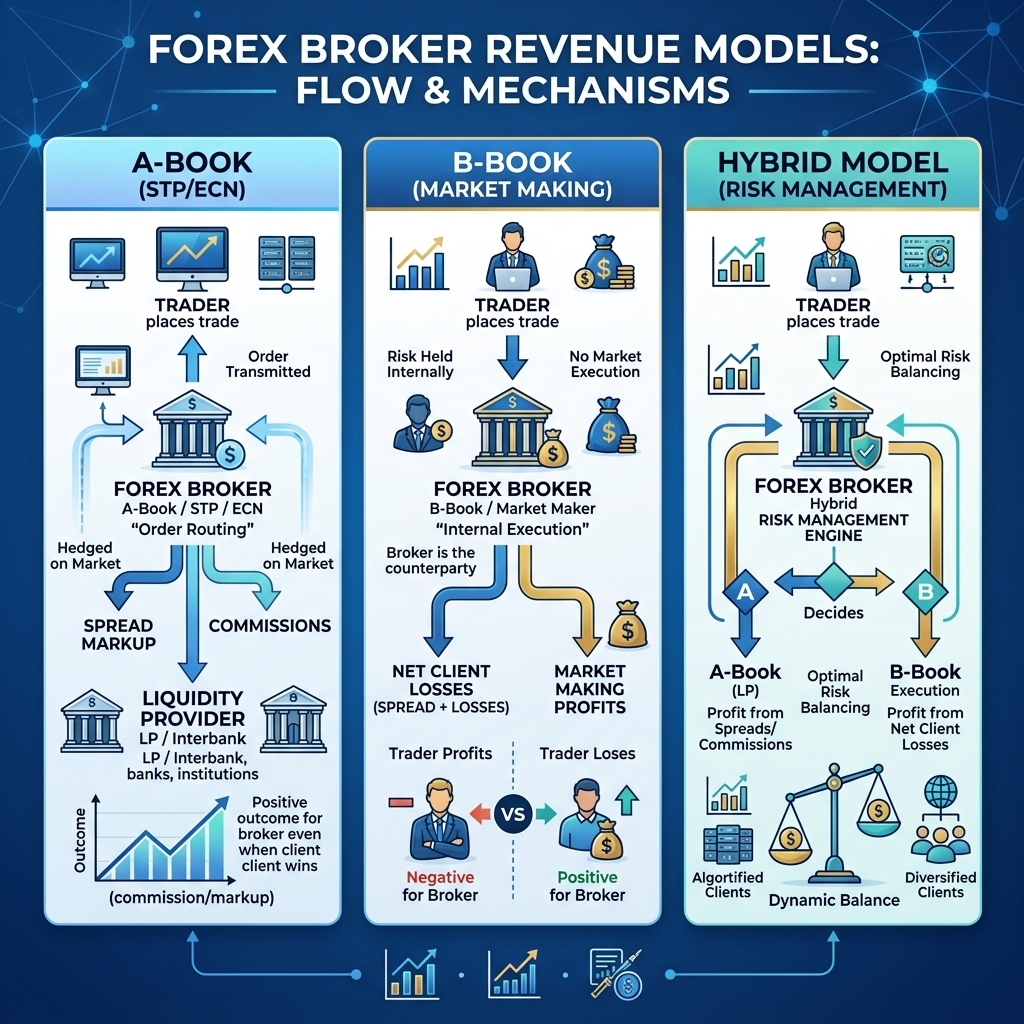
Visualizing the transition from retail order to institutional liquidity across different models.
3. The Hybrid Model: The Industry Standard for Scaling
Most institutional-grade brokerages utilize a Hybrid approach, dynamically segmenting order flow based on real-time analytics. This allows for optimized margin capture while insulating the firm from "Toxic Flow" or highly profitable professional traders.
- Automated Client Profiling: Traders are grouped into "Books" (e.g., Book A for professionals, Book B for standard retail) based on trading behavior, win rate, and directional bias.
- Dynamic Hedging Triggers: Automated rules that trigger external hedging (A-Booking) when a specific client’s exposure exceeds predefined thresholds.
- Margin Optimization: By internalizing standard retail flow and externalizing "Smart Money," the broker achieves the highest possible risk-adjusted return.
4. Technology Stack: The Backbone of Execution
Implementing these models requires more than just a trading platform. Founders must invest in:
- Liquidity Bridge: Tools like OneZero or Gold-I to manage complex routing and LP connectivity.
- Real-time Risk Dashboard: For monitoring aggregate exposure and margin health.
- Execution Reporting: To ensure transparency and compliance with regulatory standards.
Conclusion: Strategic Recommendation for Founders
There is no "one-size-fits-all" model. A startup may begin with a pure A-Book to build trust and minimize capital requirements, gradually transitioning to a Hybrid model as their risk management capacity matures. The key to long-term success lies in the discipline of your execution policy and the robustness of your technical infrastructure.
Making the A-Book or B-Book decision operational
Choosing A-Book, B-Book or Hybrid is not only a revenue decision. Trading-data quality, risk-team capacity, hedging rules and auditability must be tested before launch; a hybrid model without explicit rules can hide risk.
Controls that should not wait until later
- Define exposure, concentration and abnormal-order indicators before go-live.
- Keep routing rules and manual-intervention limits documented and auditable.
- Rehearse high-volatility, LP-outage and bad-price scenarios with operations.
To design a model around the actual order flow, Broker risk management and Calculate broker setup costs online are useful next steps.
The practical detail of each project depends on its target market, provider contracts and operating model.
Operator Note:
Decisions in this article should be adapted to capital capacity, risk model, and target market; there is no one-size-fits-all setup.