The Role of Introducing Brokers (IB) in Forex Brokerage Revenue and Partnerships
Executive Overview
A comprehensive guide on the role of Introducing Brokers (IB) in forex brokerage growth, commission structures, rebates, markups, and scaling partner networks.
This guide is written with an operational perspective for brokerage executives, technical teams, and investors who need an executable output.
Table of Contents
In the highly competitive forex industry, customer acquisition costs can be prohibitively high. This is why introducing brokers, or IBs (Introducing Brokers), serve as one of the most efficient distribution and marketing channels for any forex broker. An IB not only alleviates the direct marketing burden from the broker but also acts as a volume driver for active trading, creating a sustainable stream of dollar commission revenue. In this article, we analyze the strategic role of IBs in a broker's ecosystem and detail their key commission models.
1. What Is an Introducing Broker (IB)?
An IB is an individual or firm that refers traders to a brokerage. Unlike traditional advertising where you pay for clicks or leads, the broker only pays the IB when the referred client starts active trade execution. By leveraging local trading communities, education centers, and signal channels, IBs build deep trust and enhance long-term client retention (LTV).
- Reduced Customer Acquisition Cost (CAC): Shifting fixed marketing budgets to variable, performance-based payouts.
- Increased Volume Velocity: Educated and supported clients referred by IBs tend to trade larger volumes and have longer lifetimes.
- Local Brand Amplification: Serving as the broker's local representatives, overcoming language and trust barriers in specific regions.
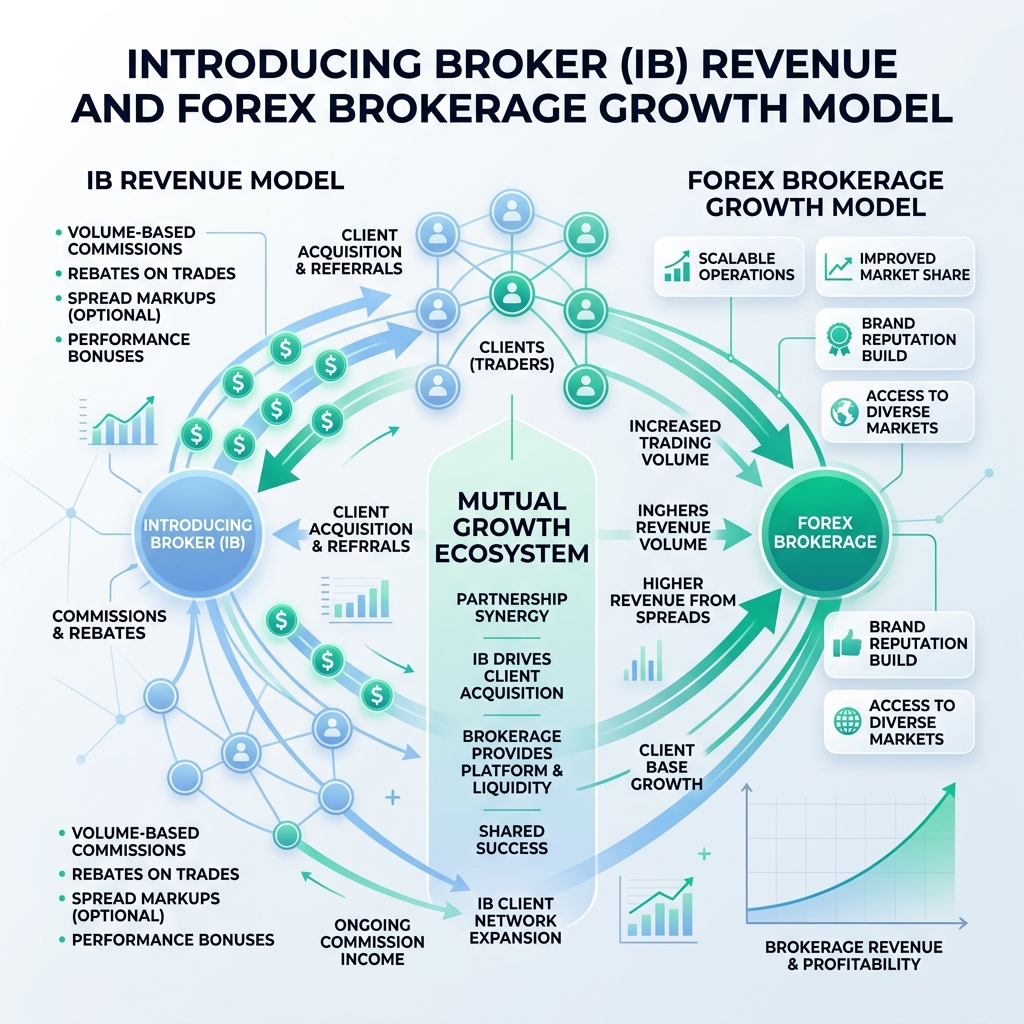
Introducing Broker (IB) Revenue Ecosystem
This infographic maps the key components of the IB revenue model: rebates, spread markups, and tiered payouts, showing how they sync with the broker's liquidity and trading engine.
2. Introducing Broker (IB) Revenue Models
Brokers deploy diverse commission structures to reward their IB networks. An institutional-grade brokerage CRM must automate these calculations in real-time.
A) Volume-Based Commissions (Fixed Lot Payout)
The IB receives a fixed dollar amount for every standard lot traded by their clients (e.g., $5 to $15 per lot). This is volume-dependent and unrelated to the client's P&L.
B) Spread Revenue Sharing (Rebates)
The broker splits a percentage of the spread earned from the referred client's trades with the IB. For example, if the spread on EURUSD is 1.2 pips, a 50% revenue share sends the equivalent of 0.6 pips directly to the IB's wallet.
C) Spread Markups
A powerful tool where the broker allows the IB to add a markup to the client's default spreads. If the standard gold spread is 2.0 pips, the IB can configure a 0.5 pip markup, making the client's spread 2.5 pips. The 0.5 pip difference goes entirely to the IB.
D) Multi-Tier Payouts (Sub-IB Networks)
Top-tier brokerages allow IBs to recruit Sub-IBs, paying them a percentage of their sub-partners' generated revenue, creating a viral, multi-level referral system.
3. Managing a High-Performance IB Network
If you are planning a forex broker launch, designing a robust partner program is critical. Your partner infrastructure must include:
- Dedicated Partner Portal: For tracking referrals, marketing materials, and real-time commission stats.
- Flexible Payments: Integrated PSPs and crypto gateways for instant partner withdrawals.
- Instant Commission Reconciliation: Payouts credited immediately upon trade closure to foster partner loyalty.
Conclusion
Aligning an attractive IB program with quality liquidity providers and balanced risk execution like A-Book and B-Book models establishes a highly scalable broker ecosystem. Managing these partnerships through custom CRMs ensures long-term commercial growth and market authority.
Operator Note:
Decisions in this article should be adapted to capital capacity, risk model, and target market; there is no one-size-fits-all setup.